Mirror therapy is one of the methods used in neurological rehabilitation — especially for some patients after a stroke — to support recovery of movement and improve how the affected limb performs.
It relies on visual feedback to help the patient relearn movement, drawing on the brain's ability to adapt and reorganise its connections, known as neuroplasticity.
What is mirror therapy?
Mirror therapy — also called mirror visual feedback — places the unaffected limb in front of a mirror, with the affected limb hidden behind it, so the patient sees the reflection of the healthy limb as if it were the affected one.
When the healthy limb moves, the mirror creates an image that suggests the affected limb is moving too. This visual illusion aims to provide input that helps activate movement-related networks in the brain and support motor learning.
The technique was first used for phantom limb pain, and its applications were later studied in other conditions, including stroke and complex regional pain syndrome (CRPS).
Why use it after a stroke?
After a stroke, a patient may have weakness or difficulty controlling the arm, hand or leg because the brain areas and pathways that control movement have been affected. Rehab isn't only about strengthening — it also involves repeated movement practice, better motor control and supporting the brain's ability to adapt.
Mirror therapy adds visual feedback during movement practice and may help support recovery of movement when combined with a suitable rehab program.
How does it affect the brain?
- Visual feedback: the reflection of the healthy limb provides visual information linked to movement.
- Supporting motor learning: the patient can practise movements and watch them repeatedly.
- Activating movement networks: watching the intended movement may influence activity in the brain's motor networks.
- More attention to the affected limb: practice may help direct the patient's attention towards it.
Responses vary between patients. Watching the reflection doesn't necessarily mean the affected limb will move or recover on its own.
What are the benefits after a stroke?
Studies suggest mirror therapy may help some aspects of motor recovery, with the strength of evidence varying by outcome:
- Motor function: may improve some movements of the affected limb, especially the arm.
- Supporting movement in hemiparesis: may be useful even when voluntary movement is limited, as the patient focuses on the reflection at their own level.
- Activities of daily living (ADLs): movement gains may carry over to tasks like dressing, eating and holding objects, depending on recovery.
- Pain: studied in phantom limb pain and CRPS. For pain after a stroke the evidence is mixed, and a response can't be guaranteed.
- Spasticity: some studies show improvement in certain groups, but it isn't a guaranteed way to reduce spasticity or stiffness.
- Awareness of the affected limb: visual feedback may increase attention to the affected side, but treating visuospatial neglect needs specialist assessment and interventions, not the mirror alone.
How is it done?
- Positioning and set-up: the patient sits comfortably and safely; the mirror is placed at the midline, reflecting the healthy limb while the affected limb is hidden behind it.
- Focusing on the reflection: the patient is guided to watch the reflection and try to perceive it as the affected limb moving.
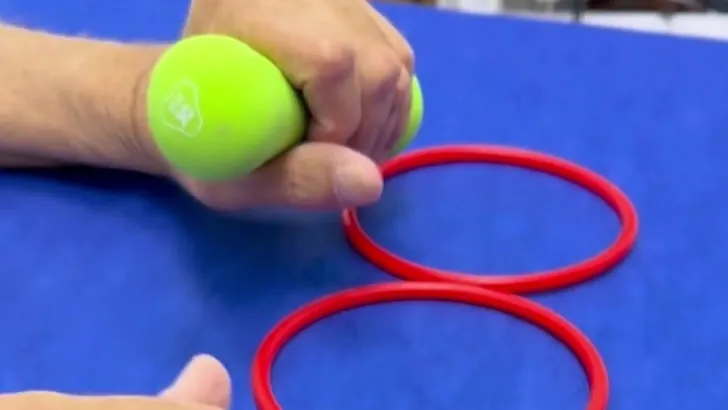
- Performing movements: starting with simple, repeated movements — opening and closing the hand, moving the fingers and wrist — according to the goal and ability.
- Progressing with the response: difficulty and duration are adjusted, with functional training added when appropriate.
It's carried out within a plan set by the physical therapist, taking into account the patient's position, concentration and tolerance.
Which exercises are used?
- Hand and fingers: opening and closing the hand, bending and straightening the fingers, finger tapping.
- Wrist and forearm: bending and straightening the wrist, turning the forearm when suitable.
- Leg: mirror-therapy principles may be used in some foot and ankle protocols, depending on the assessment.
- Functional training: visual feedback may be combined with functional tasks suited to the patient's abilities and goals.
Walking practice with a mirror is a different application from the classic form and needs attention to balance, fall risk and supervision.
Who is it for?
- Weakness after a stroke
- Difficulty with voluntary movements of the hand or arm
- Some chronic pain conditions, depending on the diagnosis and type of pain
- Some cases of complex regional pain syndrome (CRPS)
- Selected movement or sensory difficulties, when the rehab specialist considers it suitable
Weakness alone doesn't decide it — the diagnosis, cognitive and visual abilities, attention and rehab goals all matter.
How strong is the evidence?
Reviews suggest there is evidence supporting mirror therapy for improving motor function and some daily activities after a stroke, with the reliability varying by outcome, patient characteristics and program. Benefits for pain, visuospatial neglect or spasticity need more cautious interpretation, as results differ between studies.
That's why it's best used as part of an integrated rehab program — not instead of therapeutic exercise and functional training. (Read: coordination exercises after a stroke)
How we use it at Back On Track
Mirror therapy can be part of our neurological rehabilitation programs for patients whose condition calls for it, especially after a stroke. Sessions are based on an assessment of the patient's abilities and goals, choosing suitable movements and guiding them to focus on the reflection during practice. Programs may include hand, finger and wrist exercises, combined with other movement and functional exercises as needed.
Our aim is to support recovery of movement, improve daily activities and build independence through an individual plan for each patient.
Frequently asked questions
Can it be used if the patient can't move their hand?
Yes — it can be used for some patients with severe weakness or no voluntary movement, because the exercise relies on watching the reflection of the healthy limb. Whether it's suitable depends on the assessment.
How long is a session?
It varies with the patient's condition, tolerance, goals and the protocol used. The physical therapist sets the session length and repetitions.
Does mirror therapy treat a stroke?
No. It doesn't treat the stroke itself, but it may help some aspects of motor recovery for some patients, as part of a rehab program.
Does it replace physical therapy?
No. It's usually used within an integrated plan that includes therapeutic exercise, functional training and any other interventions the patient needs.
Is it right for every stroke patient?
Not necessarily. The rehab specialist decides based on the patient's movement, cognitive and visual status and ability to take part in the exercises.
Summary
Mirror therapy is a rehab method that uses visual feedback to support movement training, and it may help improve motor function and some daily activities after a stroke. Benefit depends on choosing the right patient, doing the exercises correctly, and building them into an individual plan based on a physical therapist's assessment.